Rebecca Zook - Math Tutoring Online

Get your free copy of 5 Tips You Must Know to Stop Freaking Out About Math!

Call me free of charge to discuss your situation, and we'll see if I can help.

617-888-0160

Triangle Suitcase: Rebecca Zook's Blog About Learning rssfeed

Posts Tagged as "math anxiety"

The treachery of invisible math anxiety

Thursday, January 5th, 2017

Getting ready for my upcoming presentation on Making Math Magical!

My brother introduced me to the term “math anxiety” while I was in high school.

When I first heard it, I felt massive relief that there was actually a term for what I was experiencing! That meant I wasn’t the only person suffering through it!

But math anxiety can mean MANY different things.

It can look like:

You’re doing everything you can, and you’re not doing well.

This is what a lot of people associate with math anxiety – despair, overwhelm, crying, puking, and most of all, failure and bad grades.

OR

You’re doing everything you can, and you’re doing “well,” but it doesn’t actually make any sense!!

This is what I call “invisible” math anxiety.

If this keeps happening, over time…

-you become afraid that’s something’s wrong with you,

-you become afraid that you’ll never get what you need (because you aren’t getting it now and you’re already doing your best)

-and you give up on it ever feeling clear, pleasurable, meaningful, enjoyable, or a cohesive whole that actually makes sense.

You just focus on—or settle for—going through the motions.

Getting through this night’s homework.

Getting through this test.

Getting through this class.

Getting through this degree.

What’s really insidious, and tragic, about invisible math anxiety, is that it can happen very slowly and even to students who appear very successful on the outside.

Recently, over dinner, a woman shared with me how when she was growing up, she got math tutoring and made Bs, but she never really felt like math made sense to her.

The tutoring was just about getting through her homework and getting through her tests.

She wanted to be a doctor, but chose not to do pre-med in college because she was afraid of the math requirements.

Then, when she worked in retail, she wanted to be a buyer—a powerful position as the person behind the scenes who chose the merchandise—but never sought that promotion because of all the math involved.

Worst of all, she ended up in an abusive relationship, because she didn’t think she could take care of herself financially on her own.

All because of math anxiety.

And this is a B student we’re talking about — who everyone else thought was doing fine!

It doesn’t have to be that way.

I’m on a mission to shift the paradigm from “just getting through it”

to “actually understanding it and mastering it and loving it”

so you can REALLY make your dreams come true,

instead of giving up on them out of math fear.

Math is a world in which we can all belong, in which we can all experience clarity and joy.

If you sense your child is struggling with any kind of math anxiety — whether it’s the classic “visible” type, or the more insidious “invisible” type, I’d love to connect and explore how I could support your child in truly loving and mastering math.

To take the first step, just fill out my super special application here.

Once your application is received, I’ll reach out to schedule a special time for us to talk on the phone about if my work would make sense for you.

Sending you love,

REBECCA

Related posts:
Afraid your math teacher will judge you?
What to do when your kid’s math terrifies you
Face your fears, get a higher grade

Posts Tagged as "math anxiety"

How to raise a math-confident daughter (for parents): Thurs 1/12 at the Old Bridge Public Library

Wednesday, January 4th, 2017


Preparing for “End the Math Freakout”!

Next Thursday, January 12th at 7:30 pm, I’ll be speaking to parents at the Old Bridge Public Library in Old Bridge, NJ on how to raise a math-confident daughter!

Come and join me, and please spread the word to parents who you think may be interested!

Math can be an enormous source of parental anxiety, where even the most math-confident parents can find themselves stuck when it comes to supporting their own child. Make sure that math anxiety isn’t an obstacle to your daughter’s dreams.

This talk/workshop will provide you with groundbreaking tools to build and nurture your daughter’s math confidence, including:
• the difference between perfectionism and mastery
• growth mindset
• how to use “negative” emotions to achieve math success
• flow state (how to use the sweet spot between boredom and overwhelm)
• mastery orientation, and more

You will discover how to support your daughter to achieve true mastery, rise to the top of their class, and even come to experience math as a source of joy and a type of self-expression. You’ll walk away with clear steps, case studies, and tools that you can use immediately at home to ensure math confidence and success.

Talk title: End the math freakout: How to raise a math-confident daughter
THIS TALK IS FOR: Parents of creative, passionate, unique daughters from 4th grade through high school who are having issues with math and know that something needs to change.
Date: Thursday, 1/12
Time: 7.30-8.30 pm
Location: Old Bridge Public Library
1 Old Bridge Plaza
Old Bridge, NJ 08857
Cost: Free and open to the public.

I would love to see you there!
Sending you love,
REBECCA

Posts Tagged as "math anxiety"

Case study: a 10th grader goes from feeling like math is a foreign language to being the most-called upon student in her class

Wednesday, October 26th, 2016

When this student first came to me just before the summer between her freshman and sophomore years, her mom told me that the tutor they’d just worked with had told the family that to this student, math was like a foreign language where she only spoke five words.

Somehow she’d made it to the end of 9th grade with Bs in math, but none of it actually made any sense to her. It was like she just knew enough to “get around” – like how to ask where the bathroom was and order a hamburger – but not enough to really understand what was going on around her, or communicate herself.

Once we started working together the summer before she headed into pre-calculus, this student’s mastery, confidence, and grades began to steadily improve. By mid-sophomore year, my student’s teacher mentioned to her that he had to be careful to call on other students because my student always gave the correct answer!

The “piece de resistance” was when my student had to take an oral final for her math class at the end of her 10th grade year. Her teacher gave them five very sophisticated problems that synthesized everything they’d ever learned in new ways they hadn’t seen before. They had unlimited time to prepare, and then each student was asked to explain one of the five problems, picked at random on the spot, in front of the entire class. My student did such a good job that she got an A, and she told me later that she walked out of that class feeling like, “I can do anything!”

When it came time for this student to decide what math class to take after pre-calculus, instead of taking the statistics class that many students take as a way to avoid math, my student opted to enroll in AP AB Calculus. Because math had become beautiful, fascinated, and intrinsically rewarding to her, she wanted to keep exploring and growing.

Here’s how this student and I worked together to completely transform her experience of math from a source of unbelievable stress and anxiety into a source of joy and strength:

1. We worked in an atmosphere of total camaraderie and trust. Our tutoring sessions were totally a lighthearted, safe zone where there was absolutely no judgement. This student was free to ask as many questions as she wanted, go over as many examples as she desired, or go over the same example as many times as she required, without any fear of being embarrassed.

2. We focused on filling in the gaps, while also addressing whatever she needed to learn that week or that day. When we would go over her current material and encounter a gap, we’d keep excavating backwards through the layers of prerequisite knowledge until we found the original misunderstanding. Then we’d fill that in, then the idea on top of that, then the idea on top of that, until we’d build back up through the layers to what she was responsible for learning today. This way she was able to repair gaps in her foundational knowledge, while also staying on top of her weekly curriculum and being prepared for tests and quizzes.

3. We really focused on approaching the material in a way that worked for HER. This particular student craves conceptual understanding, so we would approach the material from different angles until she understood WHY it worked that way. She also loves learning math visually, so we would frequently approach concepts and procedures in a visual way – like FOILing using a box instead of just parentheses – that made the concepts more intuitive for her, and easier to internalize.

During moments like this, she would share observations like, “I don’t know how I lived through math without completely understanding this, because it’s so much easier than I thought it was. My whole childhood with math has been completely relearned.”

As my student’s mastery naturally led to greater confidence and grades, her enthusiasm for math grew more and more. She recently shared with me, “This is actually so cool – when actually I understand it, it’s so much fun!”

Would you like your daughter or son to go from feeling like math is a foreign language to experiencing math as genuinely enjoyable, meaningful, and fascinating?

Just click here to get started with your special application for my one-on-one math tutoring programs.

Once your application is received, we’ll set up a special complimentary phone call to get clear if it would be a fit for me to support your child with math. I can’t wait to connect!

Related posts:
Case study: a 5th grader goes from believing “math doesn’t like me” to singing and dancing about math while wearing a purple tutu
Case study: a rising 8th grader masters her summer math packet
How to multiply binomials using a box (alternative to FOILing)
An easy way to remember how logarithmic notation works

Posts Tagged as "math anxiety"

Afraid your math teacher will judge you?

Monday, February 15th, 2016

10425374_767320963315223_6572653159629973572_n

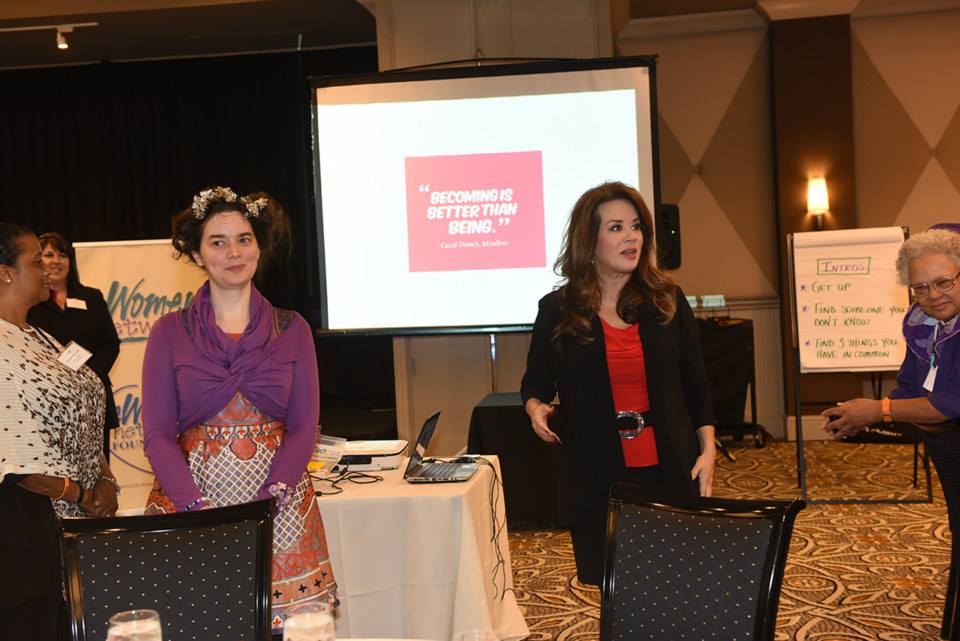
Me (on the left) attending a workshop with Sandra Yancey (right), one of the most powerful female entrepreneurs in the world. I love the Carol Dweck quote in the background… “Becoming is better than being.”

This past week I got to attend an entire day-long workshop with Sandra Yancey, one of the most powerful female entrepreneurs in the world. This woman grew a huge national network and multi-million-dollar business from a handful of business cards. She is a powerhouse!

Out of the entire day, one of the things she said that struck me the most was, “We cannot thrive unless we have a place where we can be real.”

This is completely true for me personally – and why it’s essential for me to have my own mentor and my own colleagues and friends that I can be truly real with.

And I know it’s also so true for my students.

For example, I was recently in a session with one of my students, talking about whether or not she would ask her math teacher a particular question.

She stopped and said, “I’m afraid he’ll judge me.”

Wow! That is EXACTLY how I felt so many times when *I* was struggling with math growing up!

I had just never articulated it to myself before.

Even with math teachers who were really nice to me, sometimes even the niceness felt like a form of judgement. I’m highly sensitive, so I could FEEL it when someone was internally exasperated, but trying to act patient when I asked a question about something I “should have” already had down.

Is this something that you’re struggling with? Are you afraid that if you ask questions in class, your teacher will judge you?

(This can be especially difficult if you are a great student in every other subject. You’re used to doing your best and SHINING in the classroom when you participate, but with math, instead of shining, you fear that if you ask your questions, you’ll be judged or even feel ASHAMED that you don’t already know the answer.)

If this is what you’re facing, here’s what I recommend:

1. First, let yourself acknowledge this feeling. Don’t ignore it. Pay attention to it.

Why? If you ignore it, you will just subconsciously shut down on some level. You’ll stop seeking help, and on some level, you might even stop believing that anyone CAN help you, and that you’re doomed to feel this way forever.

It’s OK to recognize that asking for help in a particular situation, or asking for help from a particular person, might not be the best way to master the material.

2. Second, don’t judge yourself. When there’s a disconnection between your learning and how things are being taught in the classroom, it can be easy to start to despair or even start telling yourself things like “I’ll never get this… I must just not be a ‘math person’… maybe my brain is just not made for math… What is wrong with me, I am so good at every other subject… How can I be trying so hard and still be so confused…”

Emotions have a huge impact on learning, especially when we’re being challenged like never before. Be compassionate with yourself. Remember, math is a skill that you can acquire with persistent effort. There’s just some kind of disconnect happening between how you’re being taught and what you need to truly master the material. Nothing is wrong with you. Just be gentle and kind with yourself. ESPECIALLY if you are afraid others won’t be gentle and kind with you.

3. Third, be SUPER CLEAR with yourself exactly what it is that you have a question about. When you start to feel overwhelmed about math, it’s easy to look at something and just completely give up because your eyeballs don’t recognize it right away. It’s a completely natural human response – and, it’s also a very knee-jerk, superficial way of engaging with the material.

Take a deep breath. Take a break. Then come back to the material and look at it so, so slowly. Try to take it apart. Ask yourself questions. Why are they doing this specific step here? Does it remind you of something you already know how to do? Let yourself read the math book and do the problem at like one mile per hour.

Try to refine your question from something super general like “I have no idea what’s happening here and I just want to burst into tears and throw this book out the window” to “OK, why did they substitute ‘u’ in for ‘x’? How did they get from step 2 to step 3? Where can I see another example?”

Paradoxically, getting super clear with yourself about EXACTLY WHAT YOU’RE CONFUSED ABOUT is a way to… un-confuse yourself. I promise!

4. Finally, find a place to ask your math questions where you aren’t afraid of being judged. A place where it is safe to be real. Your math classroom and math textbook are not the only source of math knowledge. Try your friends, your peers, teachers you’ve had in the past that you understood better, a different textbook, an online video.

Or, if you’d like to explore whether my magical one-on-one math tutoring programs would be a fit for you and your family,
just click here to get started with your special application. Once your application is received, we’ll set up a special phone call to get clear if my approach would be a good fit for your child. I look forward to connecting!

Related posts:
Face your fears, get a higher grade
Math student’s bill of rights
I just can’t keep this a secret any longer
Case study: confused by math instruction in a foreign language

Posts Tagged as "math anxiety"

How to raise a math-confident daughter (or son) (1)

Friday, January 15th, 2016

smaller high five

That’s me speaking at AAUW’s Tech Savvy event for 6th-9th grade girls and their parents!

Is your child plagued by math anxiety, even though they’re already busting their butt?

Or do you really want to support your child to be truly math-confident, but don’t know how to connect with them about math?

I recently got to speak to parents about “How to Raise a Math-Confident Daughter (or Son)”, and the response was so phenomenal that I wanted to share the highlights with you!

This approach totally works whether you’re coming at it from a parenting perspective or applying it in your own classroom or community.

I’ve come to understand that being math-confident all comes down to developing and nurturing a Mastery Mindset.

1. The first piece of a mastery mindset is to have a Growth Mindset – knowing that math is a skill that everyone can nurture and develop with effort. (Carol Dweck has an awesome body of research about this.)

One of the ways I help my students develop a growth mindset is through using empathy to create an atmosphere of camaraderie and trust, so students feel really safe to talk about what they don’t understand.

I’ve come to understand that what keeps us from understanding math isn’t our intellect, but our emotions. And instead of ignoring our emotions, we can respect them and work with them as a tool to create mastery.

For example, there’s a student who came to me at the end of her Algebra 2 year. Math felt like a foreign language to her. By working with her emotions explicitly as part of our work, she ended up becoming the star of her pre-calculus class, nailing her oral final in front of her entire class, and enrolling in Calculus because math became something she loved.

An easy way that you can start to use empathy to develop a growth mindset is just to ask your child the very simple question, “On a scale of 1 to 10, how does this feel?” This also helps students develop the super powerful meta-skill of self-assessing their own mastery.

Would you like your child to receive super-customized, one-on-one support in developing their own math mastery mindset – so math becomes something totally doable and enjoyable?

Just click here to get started with your special application for my one-on-one math tutoring programs. Once your application is received, we’ll set up a special phone call to get clear if my approach would be a good fit for your child. I’m excited to connect!

Related posts:
The secret to getting straight As in math (it’s not what you think)
“Now I feel connected to math”
The Secret Ingredients of True Math Mastery
Do you wish your kid could feel like Albert Einstein?
Does having a math tutor make you a “loser”?

Posts Tagged as "math anxiety"

Come meet me in person in Maryland – Thursday 1/21 at 7 pm!

Tuesday, January 12th, 2016

15.10.24STEMDuyTran (518)

I have a super special speaking engagement coming up in Maryland, and you’re invited!

This is a rare opportunity to meet me in person (for free) in a very intimate, powerful group.

How to Sing and Dance about Math:
For Musical Theater Teens and Tweens (and their parents)!

Are you so busy prepping for musical theater auditions, rehearsing, and performing, that you don’t have a lot of time for math homework?

Do you ever feel overwhelmed and stressed about math?

Do you wish you could get your math homework done easily and quickly?

Do you want math to be something you sing and dance about–something you love and enjoy as much as musical theater?

(more…)

Posts Tagged as "math anxiety"

Want to meet at the NCGS conference?

Tuesday, June 9th, 2015

Photo on 6-23-15 at 9.11 PM #2
Practicing a full butterfly regalia hair-do in preparation for my presentation
#bathroomselfie #thisishowweroll #powerhair

Hey there! If you’re planning to be at the National Coalition of Girls Schools Conference this June in Richmond…

I just wanted to let you know that I’ll be giving a talk at the conference:

“Secrets of the Math Mastery Mindset:
How to help girls who are failing, freaking out, or secretly crying themselves to sleep about math
to rise to the top of the class and transform their relationship with math forever”

Wed, June 24, 2015
11.15 am or 11.45 am (2 back-to-back 25-minute sessions, you can attend either one)
St Catherine’s School Dining Hall
(look for the table with purple butterflies)
Richmond, VA

You are invited!

Let me know if you’ll be at the conference – I’d love to see you there!

Photo on 7-14-15 at 6.05 PM

Posts Tagged as "math anxiety"

What to do when your kid’s math terrifies you

Thursday, January 8th, 2015

“This is terrifying,” my student’s mom confided in me as we discussed my student’s taking one of the most advanced math classes you can take in high school. “What my daughter is doing is way beyond any math I’ve ever attempted.”

Does this sound familiar? Your kid is doing math that, if you needed to explain it to them, you would have a panic attack? mental meltdown? total and complete incomprehension?

This is a situation that I face all the time. Sometimes a kid’s math will cross the “parental capability threshold” in elementary school. Sometimes it’s middle school. Sometimes, high school, or even college. But unless you, the parent, are actually a math professional or math educator, it’s very normal for there to come a point where you absolutely can no longer help your kid with math, no matter how much you WANT to help them with it, unless you take it upon yourself to teach yourself from scratch how to do it (and sometimes, not even then).

If this is what’s happening to you, here’s what to keep in mind:

Just because you are terrified doesn’t necessarily mean that your kid is terrified. Don’t assume you and your kid feel the same way about the math they’re being asked to do. Your kid is surrounded by other kids who are also doing terrifying math, and it might even feel normal to them. Maybe they feel proud or excited to be doing it! It is possible that they also feel terrified like you do. But just remember that it’s possible that you won’t be having the same emotional experience about it.

Don’t underestimate your kid. (Especially based on your own math experience). Maybe you tried to do this level of math and failed. Or maybe even considering doing this level of math was so terrifying that you opted out, during your own education. Maybe you never had an opportunity to even TRY to learn this level of math. No judgement!

However, keep in mind, your past math performance does not predict your kid’s future performance. Even though a lot of people in our culture talk about math ability like it’s a genetic trait, truly, truly, TRULY EVERYONE can learn to do math if it’s explained to them in a way that they can understand. Math is not a talent. It’s a skill that can be acquired with practice and persistent effort. Please remember this if you start to feel terrified about what your kid has taken on.

You don’t have to be able to do the terrifying math yourself in order to be a good parent. It is normal as a parent to passionately want to give your own kid every possible opportunity to thrive. You want to teach them everything they need to know to succeed in the world on their own. How can you do this once the math they’re doing surpasses what you yourself have learned?

Do not fear. You do not have to teach them terrifying math yourself! Sometimes the best thing you can do as a parent is make sure that someone else is helping your kid with the terrifying math for you, and just step back and focus on being a mom or dad, not on having to be a math teacher after you come home from a full day’s work.

Are you ready to invest in having someone else – who is caring, empathic, adventurous, and super experienced – help your passionate, creative kid with the terrifying math, so you can just focus on being a parent?

Just click here to get started with your special application for my one-on-one math tutoring programs. Once your application is received, we’ll set up a special phone call to explore whether or not my magical math tutoring programs would be a fit for you and your family!

Related posts:
How to know when it’s time to stop tutoring your own kid
Afraid your math teacher will judge you?
Math student’s bill of rights
Face your fears, get a higher grade

Posts Tagged as "math anxiety"

When doing your math homework just isn’t cutting it

Thursday, March 27th, 2014

2014-03-18_2146
What if math could make you jump for joy?

Did you ever take the Presidential fitness tests growing up? I vividly remember being asked, about once a year, to run a mile. Even though I got a lot of cardio growing up from serious ballet training, running the mile in middle school and high school pretty much always made me feel like I was going to die. Even if I actually ran the whole thing, there would always come a point midway where it literally felt like my lungs were bleeding inside.

Looking back at this experience, I was like, what the heck were the PE teachers thinking? If you only run a mile once a year of course you are going to suck at it and totally hate it!

What about actually creating a physically fit generation by nurturing students to LOVE to run… not just endure a yearly test? What about actually creating a generation of students who LOVE to do math… not just “get through it” to make the grade?

Whether you’re at the starting line of a race, or freaking out the night before a math test, whenever there’s a gap between what we’re being asked to do, and our preparation, it can create a lot of stress and fear.

And very frequently, the reason you will have trouble in math, or with your physical fitness test, is because – bottom line – the practice you’re assigned is NOT ENOUGH for you to really master the material and be prepared for the task.

Ironically, usually when you’re in that “freaking out” place, the last thing you want to do is do MORE of what is freaking you out… whether it’s running a mile or doing math problems.

It actually requires a significant shift in your mindset, away from “let me just get through this” to “how can I truly master this so I can consistently perform at the level I desire”… And working from that new place of aiming for true mastery is so much more rewarding and satisfying… you can even learn to LOVE what used to fill you with fear and despair.

I’ve seen this transformation in my own life and also in so many of my students’. What I’m talking about here is a much higher and deeper level of taking personal responsibility for your own experience. And the beautiful result of this is realizing that whether or not you “make it” is really, truly up to you, not your teacher’s agenda or assignment schedule.

So how do you DO this? Let me share some super easy to implement tips for how to customize your own “math workout” when you know that your homework alone is not enough.

Here are some great ways to create extra practice that matches what you’re already working on:

1. Super simple: if you are assigned the evens, do the odds for extra practice, or vice versa. Just be sure that you’re able to check your answers somehow so you know you’re practicing things correctly.

(extra tip: If the answers aren’t in the back of the book, you can check a lot of math problems by plugging them into www.wolframalpha.com and it will tell you what the solution is. Just a word to the wise: Wolfram Alpha is a very powerful tool, and it often includes a lot of extra information that might be way more than what you’re looking for or need, so don’t get overwhelmed by all the “extras” – just pay attention to the parts you need, like a solution for ‘x’, for example. Just trust that the more sophisticated stuff will make more sense later on in your math learning adventure!)

2. Look for an ‘extra practice’ section in the back of the book. Most math textbooks have extra practice in the back, but a lot of times teachers won’t mention it or assign problems from it. Again, it’s most valuable when the book also includes solutions to the problems so you can check your work.

3. Don’t wait until the end of the chapter to use the “study guide” or “chapter test” problems for extra practice. Most books have a chapter review at the end of each chapter which will include several extra problems for you to use, labeled by section. Use them for extra practice as you learn each section. You can always revisit them closer to the test if you like!

4. This is a little more advanced: make up your own problems by just changing a few of the numbers. This is best to use if you know there’s a way you can check your answers so you know you’re practicing correctly, or if you are feeling confident about checking your own work.

5. Invest in an extra math textbook for extra practice. (I am a fan of the Algebra 1 & Algebra 2 “Structure and Method: The Classic” books, which also make a good reference.) Use the table of contents and the index to find problems that are similar to the ones that you’re working on.

6. Get the solutions manual or teacher’s manual for your regular textbook.
When they’re available, they usually include answers to EVERY problem in the book, not just selected problems.

(Note: Please understand – my intention in suggesting this is absolutely not for students to take a shortcut and skip doing the work of the problem. It’s because it’s something I personally do when I’m learning a new math concept or technique and I want to make sure I can check ALL my work.)

7. Most important: be sure to choose problems where you can check your answers as you go, whether in the back of the book, from wolframalpha, or from a trusted friend or adult. If you don’t know if your answer is correct or not, it’s like practicing the violin wearing earplugs. The only way you know you’re really learning is if you’re getting feedback that you’re on the right track.

Are you tired of watching your kid do their homework diligently night after night, and then bomb their tests and quizzes? Do you dread trying to answer your kid’s questions about math? Are you ready to invest in totally customized support so that your son or daughter can see great results from their hard work and experience math as a source of joy and strength?

If you answered yes to those questions, you’re invited to apply to my very special one-on-one math tutoring programs!

Just click here to get started with your special application. Once your application is received, we’ll set up a special phone call to explore what’s going on with your kid and get clear on whether or not it would be a fit for me to support them! I can’t wait to hear from you!

Sending you love,
REBECCA

Related posts:
How to experience math as your own unique creation
Three simple tips for the night before your math exam
Tips for how to help your kid with their math homework
Self-made heroes: the dancers of planet b-boy

Posts Tagged as "math anxiety"

I just can’t keep this a secret any longer

Thursday, February 6th, 2014

For a long time, I’ve been hinting at this… or feeling like it was expressed already… but it’s time for me to just come out and say it, loud and proud.

I am not a typical tutor.

What I do is not typical tutoring.

My results are not typical.

My students are not typical.

In fact, I’m coming to realize that what I do is SOO different from typical tutoring that I’ve realized it’s almost confusing when people use one word, “tutoring,” to describe typical tutoring and what I do.

So it’s time for me to really be clear about how the way I work is different, and how my students receive an experience that is completely different from typical tutoring.

Because I’ve recently heard some parents describe their other tutoring experiences, and it’s so different from how I work, I am almost flabbergasted.

Here’s what I am NOT about.

Kids have told me about working with tutors who just had them memorize and regurgitate a bunch of steps. Then the kid would just forget the steps as soon as they didn’t need to use them (like three days later), because they never actually understood what they meant. This is not how I work. I am not about “just getting you through it.”

I’ve had parents describe working with tutors who would literally say, “I managed to find the answer, but I can’t explain why.” That is not what I’m about. My intention is always to have YOU be able to get to the answer, AND clearly understand why.

I’ve heard about tutors who just made sure that the kid got their homework done. This is not how I operate. Our sessions focus on developing and retaining the skills you need to complete their homework on your own. We will work on very similar problems so you are really prepared to do your homework solo. If you only practice those problems collaboratively, you won’t feel secure and confident on your tests and quizzes when I’m not there.

I’ve heard about tutoring which is just about doing worksheet after worksheet after worksheet, in silence. I know that this approach works for some kids – but that is not how I roll. Our sessions are dynamic and totally customized to you.

I know that some tutoring is just a recapitulation of what is happening in the classroom. But if that’s already not working for you, why do more of what ISN’T working? My sessions are completely individualized to each specific student, even if the way they need to the approach the material is really different from how it’s being taught in the classroom.

And I’m also not just about grades or getting kids into an honors or AP class. I’ve seen it happen time after time that good grades are just a natural byproduct of truly understanding the material. When you focus on mastery, the grades just gradually happen on their own. And if you get a grade that is not as high as you want or expect, it’s just an indication that there was some gap in your understanding that we can address together.

I am not about ad hoc support or being a bandaid. I know that some students receive tutoring inconsistently in big lumps, like four hours the night before an exam. My experience is that this does not create lasting change, and it does create a lot of drama and stress. Math is like working out – something you need to do consistently if you want to see results.

Finally, I am absolutely NOT about tutoring as a way of encouraging dependency. Some schools have told me that they are concerned that if kids receive tutoring, they will be dependent on their tutor “getting them through it,” the kid will hold up the class because they are so confused, and then the kid will barely scrape by. That is not the way that I work. Students who work with me experience genuine mastery, make a positive contribution to their math classes at school with their confidence, preparation, and creativity, and earn grades that reflect their deep understanding and ownership of the material.

OK. Phew!!!! Now that I’ve gotten that off my chest about what I’m NOT about, let me tell you what I AM about.

Mastery. What I care about is MASTERY, and my work is about the mastery process. Like an elite tennis coach or an elite cello teacher, we focus on mastering the skills of math, increment by increment, to create permanent, transformational, holistic math fluency.

Individualization.
I am constantly customizing what we are doing and what I am saying to the individual student in every single nanosecond. We find ways of approaching the material that make sense with how YOU think. We keep you in the “sweet spot” where you are challenged and growing, but what we’re practicing doesn’t make you bored (it’s too easy) or anxious (it’s too hard).

Emotional Environment. We work in an atmosphere of trust and camaraderie. Our sessions are lighthearted and filled with commitment, mutual respect, and let me just come out and say it, love! Laughter is typical. Singing and dancing is encouraged!

Consistent Mentoring Relationship.
We work within the context of a long-term, consistent mentoring relationship where we both commit to your organic, aligned math transformation. Even though I am the tutor and you are the student, we come to the table with deep respect for each other and the understanding that we both have important things to contribute to our process. We work in an apprenticeship model where the student’s self-expression and intellectual contributions are nourished and valued – even if, in the current moment, they feel totally overwhelmed and helpless!

Empathy. I can feel if a student is frustrated, overwhelmed, or elated, and adjust my approach accordingly.

Emotional Reality. I explicitly address the emotional challenges of math. Even though emotions are basically NEVER addressed or even mentioned in most academic math contexts, I have found that the reason why people give up on math is because of how they FEEL. So it is essential that we address math feelings as an intrinsic part of the mastery process. If a student has a panic attack in class, breaks down and cries, or is feeling frustrated or overwhelmed, we talk about it, honor the feelings instead of suppressing or ignoring them, and develop strategies to help them become resilient no matter what emotions come up.

Individuality is encouraged.
It has been my experience that our greatest contributions and breakthroughs happen when we are being completely ourselves. All my students are encouraged to express their individuality during our work together, whether that means jumping up and down with excitement, making up original math songs, taking a quick break to jump or dance, feeling free to move around throughout the session if they are highly kinesthetic, or even just wearing their favorite purple tutu to our sessions.

It is a vehicle. At its core, what I offer is actually not really about math at all. It is actually about learning how how to overcome the seemingly insurmountable, and we just happen to use math as a vehicle to do that.

Support is normative. Since we’re all in a continuous process of refining our skills and expanding into our own personal genius, it is normal to continue to receive top-level support even after you start to excel. After Lindsey Vonn wins a skiing medal, she doesn’t stop training. Once you make CEO, you don’t stop receiving executive coaching and tell yourself, “I’ve actually got this down.” When you are a prima ballerina, you don’t stop rehearsing with your master teacher. The kinds of students I work with want to keep receiving mentoring and experiencing this one-on-one mastery process because they want to continue to do their best and keep learning, even after they start to initially do well. Because it’s about continuous growth and expansion, there is no limit to the potential of the process.

My clients have told me that working with me is like working with a life coach, or seeing a great psychologist. One family even coined a new word for their sessions with me – instead of calling it tutoring, they call it “Zookuring.”

But no matter what you call what we do, once you realize that you can go from hating math because it’s so confusing, to loving math and experiencing it as a source of joy and strength – “no one can take it away from you,” to quote a parent whose kid experienced this very transformation. And this experience of autonomy and self-efficacy in the face of a massive challenge has a huge positive impact on what students believe they are capable of, and ultimately, what they actually accomplish during their time on this earth.

Are you tired of “typical tutoring” that doesn’t address the underlying issues? Are you discouraged by support that doesn’t take into account what your kid actually needs to understand how math actually works? Are you ready to experience the kind of joyful, individualized transformation I’ve just described?

Then just click here to get started with your special application for my one-on-one math tutoring programs. Once your application is received, we’ll set up a special phone call to get clear if my approach would be a good fit for your child.

I’m excited to receive your completed application!

Sending you love,
REBECCA

Related posts:
Failure is not the enemy
On being yourself while doing math
How to help kids be okay with things being hard
What a Balinese dancing queen taught me about praise and encouragement
What I learned on the streets of Paris…and in a Dutch grocery store